

Toothpicks, Snuffboxes, Card Cases and Canes
[Mr. Robert Ferrars] was giving orders for a toothpick-case for himself; and till its size, shape, and ornaments were determined, all of which, after examining and debating for a quarter of an hour over every toothpick-case in the shop, were finally arranged by his own inventive fancy, he had no leisure to bestow any other attention on the two ladies than what was comprised in three or four very broad stares; a kind of notice which served to imprint on Elinor the remembrance of a person and face of strong, natural, sterling insignificance, though adorned in the first style of fashion.
-Sense and Sensibility
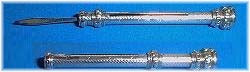 Silver toothpicks were commonly carried regency accessories in the seventeenth through nineteenth centuries. They could be quite elaborate with a jewel on the end like the example shown here.

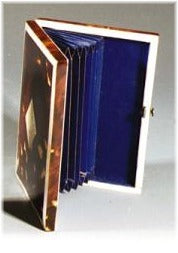 A calling card case was an absolute necessity. One couldn't be received without sending up one's card. Gentlemen put a great deal of thought into which lettering to have the card printed in and what sort of border it should have, but all Regency calling cards were printed on cream card stock. When leaving town one left cards with one's intimates with the letters PPC written on them meaning " pour prendre conge" French for " I'm leaving." When a man married he sent round cards to former acquaintances who were respectable enough to frequent his home. Anyone not receiving a card automatically understood their acquaintance to have been dropped.
 Canes were important regency accessories for a man from the late 17th century through the early 20th. A cane made of quality wood, with a silver or gold handle, told of wealth and importance. Cane shafts usually were made of wood such as ebony or rosewood or malacca. The word "cane" was not applied to the fashionable walking stick until the sixteenth century. During this period, however, the thick, jointed stems of tropical grasses known as bamboo and cane, and the reed-like stem of several species of palm and rattan were introduced for the stick. These were called "canes." From that day on, the walking stick of the past merged into the cane of the future. Today the terms are used interchangeable, Though the saying, "One strolls with a walking stick and swaggers with a Cane!" still tends to give greater dignity to the former.*
*Source: Accessories of Dress by Katherine Morris Lester and Bess Viola Oerke, The Manual Arts Press, Peoria Illinois, pp 392.)
Reprinted with persmission Sharon Wagoner, Curator of The Georgian Index. Visit their site for a historical tour through Regency London!
Canes were important regency accessories for a man from the late 17th century through the early 20th. A cane made of quality wood, with a silver or gold handle, told of wealth and importance. Cane shafts usually were made of wood such as ebony or rosewood or malacca. The word "cane" was not applied to the fashionable walking stick until the sixteenth century. During this period, however, the thick, jointed stems of tropical grasses known as bamboo and cane, and the reed-like stem of several species of palm and rattan were introduced for the stick. These were called "canes." From that day on, the walking stick of the past merged into the cane of the future. Today the terms are used interchangeable, Though the saying, "One strolls with a walking stick and swaggers with a Cane!" still tends to give greater dignity to the former.*
*Source: Accessories of Dress by Katherine Morris Lester and Bess Viola Oerke, The Manual Arts Press, Peoria Illinois, pp 392.)
Reprinted with persmission Sharon Wagoner, Curator of The Georgian Index. Visit their site for a historical tour through Regency London!
Toothpicks
Silver toothpicks were commonly carried regency accessories in the seventeenth through nineteenth centuries. They could be quite elaborate with a jewel on the end like the example shown here.
Snuff Boxes
Taking snuff were popular regency accessories, widespread pastime among the upper class and middle class English of the 18th century. Snuff boxes were made by silver smiths who specialized in tightly closing boxes. Most English snuff boxes were made in Birmingham. Snuff was a preparation of finely pulverized tobacco that could be drawn up into the nostrils by inhaling. It was also called smokeless tobacco. One of the main hazards of snuff was it's' propensity to induce sneezing fits!Calling Card Cases
A calling card case was an absolute necessity. One couldn't be received without sending up one's card. Gentlemen put a great deal of thought into which lettering to have the card printed in and what sort of border it should have, but all Regency calling cards were printed on cream card stock. When leaving town one left cards with one's intimates with the letters PPC written on them meaning " pour prendre conge" French for " I'm leaving." When a man married he sent round cards to former acquaintances who were respectable enough to frequent his home. Anyone not receiving a card automatically understood their acquaintance to have been dropped.
Canes
Canes were important regency accessories for a man from the late 17th century through the early 20th. A cane made of quality wood, with a silver or gold handle, told of wealth and importance. Cane shafts usually were made of wood such as ebony or rosewood or malacca. The word "cane" was not applied to the fashionable walking stick until the sixteenth century. During this period, however, the thick, jointed stems of tropical grasses known as bamboo and cane, and the reed-like stem of several species of palm and rattan were introduced for the stick. These were called "canes." From that day on, the walking stick of the past merged into the cane of the future. Today the terms are used interchangeable, Though the saying, "One strolls with a walking stick and swaggers with a Cane!" still tends to give greater dignity to the former.*
*Source: Accessories of Dress by Katherine Morris Lester and Bess Viola Oerke, The Manual Arts Press, Peoria Illinois, pp 392.)
Reprinted with persmission Sharon Wagoner, Curator of The Georgian Index. Visit their site for a historical tour through Regency London!Read more

Bath Jeweller
Changing Fashions: Georgian Jewellery
As the quote from Fanny Austen-Knight suggests, the Georgian period saw the increase in the use of gems in jewellery and the adornment of clothes. Pearl, garnet and different coloured topaz all bec...
Read more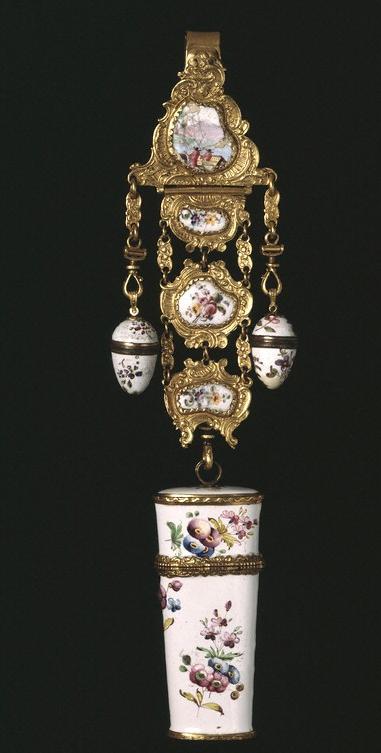
accessories
Ladies' Useful Regency Accessories
Smelling Salts, Chatelaines and Needle Cases
Read more
Leave a comment
This site is protected by hCaptcha and the hCaptcha Privacy Policy and Terms of Service apply.